It seems that the
Fujinon XF 35mm f1.4 R is the most popular lens for the X-Pro 1 and X-E1 in the current XF lens lineup. That may have two reasons:
1. The 35mm focal length on an APS-C camera equals the field of view (angle of view) of a 52.5mm lens on a regular 35mm full frame camera. And that is very close to the 50mm standard focal length that has been very popular for the past decades.
2. The XF 35mm is very sharp even at f1.4
Reason No. 1: The general popularity of a 50mm field of view lens does not apply to me personally. I consider a 35mm field of view to be my personal favorite "standard" focal length while a 50mm equivalent is a bit too long for my style of shooting. That is why I am pretty excited about the upcoming Fujinon XF 23mm f1.4 lens (mid 2013?) that will equal a field of view of a 35mm lens on a full frame camera – just like my Fuji X100.
Reason No. 2: Is something I do agree with. The lens creates sharp images, but it is hard to compare the Fuji 35mm to other 35mm lenses if those are attached to a different camera body. There would be too many variables introduced by different sensors and in camera processing that makes it hard to judge the lenses directly.
So I needed to find another lens that can be attached to the X-Pro 1 for direct comparison. Thanks to the Kipon EOS-XF adapter (
I wrote a detailed review about it in this post) I was able to test the popular and highly regarded Canon EF 35mm f1.4 L lens and see how good the Fuji XF 35mm compares to it. BTW, the Canon EF 35mm f1.4 is also my favorite and most used lens on my full frame Canon camera.
 The Canon EF 35mm f1.4 L on the left and the Fuji XF 35mm f1.4 R on the right.
Please note that this blog is not about endless test chart comparisons and pixel peeping into sub atomic levels. There are other websites who do these kind of tests. I want to see how things work out in real life the way I would use my gear.
While the main specs of the two lenses are similar (35mm f1.4) pretty much everything else is different!
The Canon EF is a full frame sensor lens and therefore it is a lot bigger and heavier (about 3 times heavier than the Fuji XF 35mm). And it is also a lot more (about twice as) expensive:
Fujinon XF 35mm f1.4 Canon EF 35mm f1.4 L
Max Format size:.............APS-C.............................................FF
Weight:...........................187g (0.41 lb)..................................580g (1.28 lb)
Min. focus:.......................0.28m (11.02”)................................0.3m (11.81”)
Elements:........................8.....................................................11
Length:............................55mm (2.17”)..................................86mm (3.39”)
Diameter:.........................65mm (2.56”)..................................79mm (3.11”)
Approx. Price:..................550 EUR (599 USD)........................1,300 EUR (1,400 USD)
In order to compare these two lenses I attached them to the Fujifilm X-Pro 1 camera. Since the Canon lens mount is different from the XF mount, I attached the Canon lens to the Kipon EOS-XF adapter. And while the Fuji lens seems to attach to the X-Pro 1 it rather feels like that the X-Pro 1 attaches to the Canon lens. Looking at the specs the X-Pro 1 only weighs 450g (0.99 lb) and is about 1/3 lighter than the Canon lens. In fact, the Canon lens is almost as heavy as the X-Pro 1 with the XF 35mm lens attached!
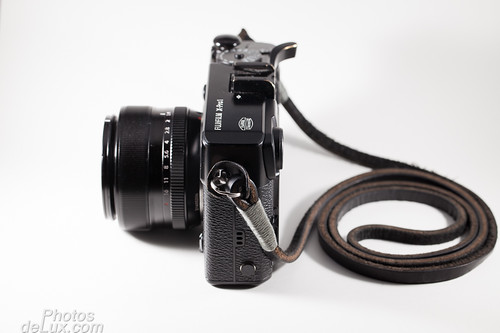 Side view of the Fuji X-Pro 1 with Fuji XF 35mm lens attached. (here is my blog post on the leather strap and thumbs grip I use)
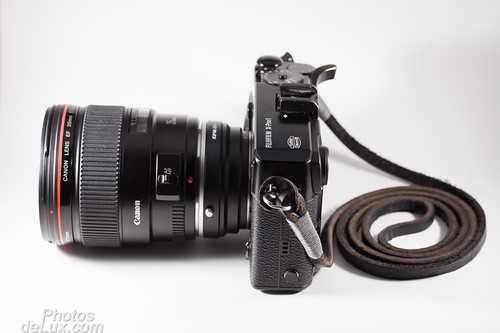 Side view of Fuji X-Pro 1 with Canon EF 35mm f1.4 L lens with adapter attached.
So much for the specs, let’s see how they compare in image quality.
I attached the X-Pro 1 to a sturdy tripod and set the X-Pro 1 to manual focus, ISO 200, shutter time 1/15s, fixed manual white balance (K) and 10 second timer to eliminate for camera shake. The photos were taken under controlled lighting.
I manually focused on the mittle of the “Rolleiflex” letters. The Canon lens does not auto focus when attached to the X-Pro 1 so I used manual focus for both lenses.
Here are the results:
Click on an image to be linked to a 100% full size view!
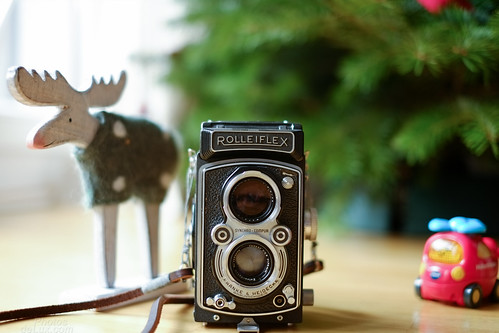 This is the result from the Fuji XF 35mm f1.4 R.
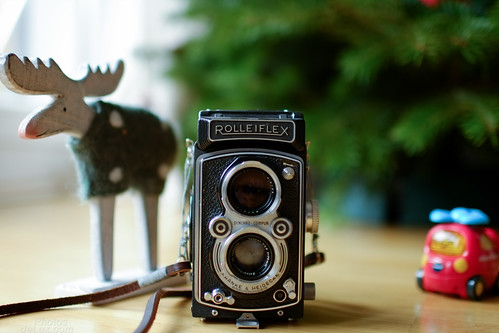 And this is the result from the Canon EF 35mm f1.4 L.
I redid this shot a few times for each lens as I noticed the difference in brigtness right away. But all variables stayed the same for both lenses - so the Canon lens seems to return about 2/3 of a f-stop darker results compared to the Fuji. So far I came up with two potential reasons for this difference:
1. The Canon lens has 11 glass elements versus the Fuji with only 8 elements. I have no idea how big of an impact this can make but it seems plausible that less glass elements between the light and the sensor will allow for more light to reach its destination. The f-stop value of a lens does not take this factor into account.
2. When the Fuji lens is attached to the camera the distance from X-mount surface to the sensor is only 1.8cm (0.7"). The light hits the sensor right after the last lens element. On the Canon EF with the Kipon EOS-XF lens adapter attached the distance is around 6cm (2.5").
I decided not to compensate the exposure on the camera to equal out the result in brightness. After all, I wanted a direct comparison between these two lenses with all factors that I can controll to be equal.
Now let's continue to image details:
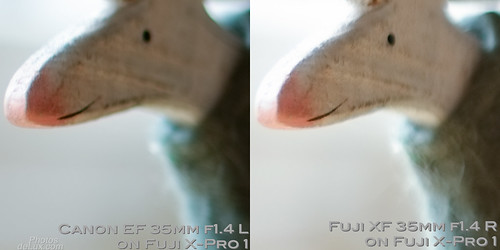 The left side of the photo shows the head of the wooden elk. This one is a bit hard to compare as the difference in luminance takes away some of the detail on the elk's nose and forehead on the Fuji lens image. But looking at the region between mouth and eye, the Fuji seems to be a bit sharper.
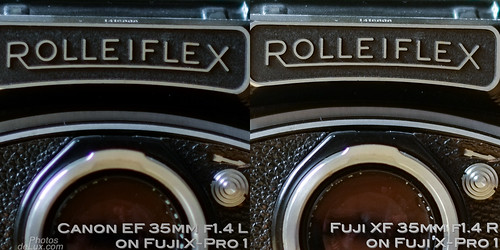 The "Rolleiflex" letters were the focus target close to the center. Here both lenses have their sweetspot but the Fuji clearly is sharper and shows less color fringing.
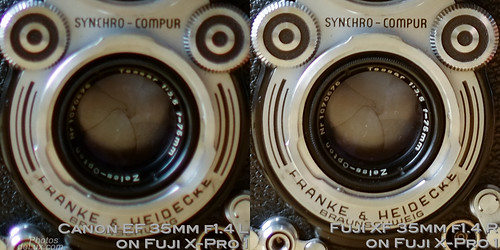 Moving a bit lower in the center of the frame the difference becomes even more apperant. The Fuji shows more detail and is sharper with a lot less color fringing. Even extra sharpening on the Canon lens image would not bring the photo up to the quality and detail of the Fuji lens.
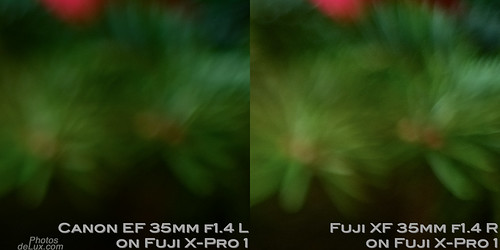 And the last sample is from the christmas tree on the top right of the image to compare the bokeh quality of both lenses. And while the Fuji's bokeh is good (here is my intensive test on the XF lenses bokeh), the Canon's bokeh is just that bit more smooth and creamy. This point goes to the Canon.
A few observations that I made during the test:
- While focusing I noticed that the Canon lens tended to show more color fringing from green to red while I was fine tuning the manual focus.
- The Canon was also more difficult to fine tune since the manual focus reacted rather fast and direct to small movements.
- The Fujinon on the other hand actually benefited from the fine graduation of the “focus by wire” setting in this situation at close focusing distances. This was the first time that I actually saw the benefit of this technology.
- The Fuji seemed to have a larger sweet spot of the sharp focus area depth compared to the Canon – even though both were set to f/1.4
I was surprised that the Fuji lens did this good in direct comparison to my favorite Canon lens!
But there is one factor in favor of the Fuji lens that also needs to be mentioned:
The X-Pro 1 recognizes the Fuji lens and applies some lens correction inside the JPG engine. The Canon lens does not get this special treatment and shows an uncorrected result from the lens. I could have partially avoided this by shooting in RAW but then the RAW converter of i.e. Adobe Camera RAW could have recognized the Fuji lens as well and add some auto correction. But in the end I wanted to see how the Canon lens compared when I use it on the X-Pro 1 in my normal use and this is what I got. The X-Pro 1 will not internally compensate for the Canon lens no matter what I do.
But if you happen to own some Leica M lenses and purchased the Fuji X-Mount to Leica M-adapter, then the Fuji will internally apply corrections to some of the Leica M lenses (i.e. the SUMMICRON-M 35mmF2 ASPH)
My resume:
The Canon EF 35mm f1.4 is a fantastic lens on my Canon FF DSLR camera. It has a fast Ultrasonic AF motor and the weight and size match the bigger camera body well. T
he Fujinon XF 35mm f1.4 R is a fantastic AF lens for the Fuji X-Pro 1 / X-E1 cameras.
This comparison has solved the question for me if I could improve the image quality by using the Canon EF 35mm f1.4 instead of the XF 35mm f1.4 for special occasions. The answer for me is “No!” and I can now comfortably leave the bigger Canon 35mm lens attached to my Canon camera.“Bigger is not always better” :)
If you have any further questions leave a comment below or Twitter me @HamburgCam
And if you liked my post I am always happy if you spread the word and retweet, like or google +1 it :-)